

This page traces every crest Bayern Munich has worn, from the 1900 monogram to the Bavarian roundel, with each era’s colors as one-click hex values.
The crest has been a monogram of F, C and B almost throughout, and the club played in Bavarian blue and white long before red.
The circular badge arrived in the 1950s, and everything since has refined the red, the blue and the shading rather than the shape.
Today it runs on red, blue and white: #ED0038 #286CFD #FFFFFF. For RGB, CMYK and Pantone, see the current Bayern Munich color codes.
FC Bayern Munich logo history timeline
FC Bayern Munich logo 1900-1901
First badge, in use only a few months: a simple flag design with horizontal blue and white stripes, reflecting the club's original blue-and-white colors.
FC Bayern Munich logo 1901-1906

Blue circular badge with a stylized 'FCBM' monogram and a golden-brown outline.
FC Bayern Munich logo 1906-1919
Colors shifted to red and white after the 1906 merger with Münchner Sport-Club, which required the change as a condition of the fusion; this is when the club earned the nickname 'Die Roten' (the Reds). Design shows an enlarged 'B' with other lettering in negative space, later a circular badge with intertwined letters on a burgundy background.
Why it changed: Condition of the 1906 merger with Münchner Sport-Club.
FC Bayern Munich logo 1919-1924
Several short-lived designs: an octagonal badge with a thick gold outline and green background, then a circular badge with white 'Bayern' lettering on red with a white-and-blue rhomboid pattern reintroducing blue as the Bavarian diamond motif, then a white 'FC Bayern' wordmark on a solid red circle.
Why it changed: Reintroduction of blue via the Bavarian diamond/lozenge pattern as a symbol of the club's home region, taken from the coat of arms of the Free State of Bavaria.
FC Bayern Munich logo 1924-1954
Oval badge with the Bavarian blue-and-white rhomboid pattern and gold stylized lettering; this basic design (first drawn around 1923) remained the club's identity for roughly three decades, though it was suppressed during the Nazi era.
FC Bayern Munich logo 1938-1945
No logo is shown here. The badge of these years carried the swastika that the regime imposed on German clubs, and it is not reproduced on this page.
During the Nazi era the regime forced German clubs to display Nazi symbols on their crests; Bayern's badge carried a swastika and the Reichsadler (imperial eagle) in its inner circle, replacing the club's own emblem for the duration. The club, whose Jewish president Kurt Landauer had been imprisoned in 1938, was derided by the regime as a 'Judenklub'.
Why it changed: Nazi regime required German sports clubs to incorporate state/party symbols into their crests.
FC Bayern Munich logo 1945-1954
After the fall of the Nazi regime in 1945, the club dropped the swastika/eagle and reverted to its own 1923-designed blue-and-white diamond crest.
Why it changed: End of Nazi rule in Germany allowed reversion to the club's own pre-war emblem.
FC Bayern Munich logo 1954-1996
Refined circular design retaining the Bavarian rhomboid pattern with cleaner lettering; went through incremental sub-revisions (commonly dated around 1961, 1965/66, 1970 and 1979) tightening proportions and modernizing the typeface while keeping the same basic red-circle-with-blue/white-diamond structure.
FC Bayern Munich logo 1996-2002
Added gradient shading and a dimensional (3D) look to the circular badge, reflecting mid-1990s logo design trends, while keeping the red ring, white 'Bayern München' wordmark, and blue/white diamond centre.
Why it changed: Followed the era's design trend toward gradient/3D-effect logos.
FC Bayern Munich logo 2002-2017
Flat, clean circular badge that removed the 1990s 3D/gradient effects and restored a flat look; thicker blue outline than the previous version, red outer ring with white 'FC Bayern München' text, and the blue/white Bavarian diamond centre with the 'FCB' initials.
Why it changed: Return to a flatter design after the 1990s 3D trend faded; developed internally by the club.
FC Bayern Munich logo 2017-2024
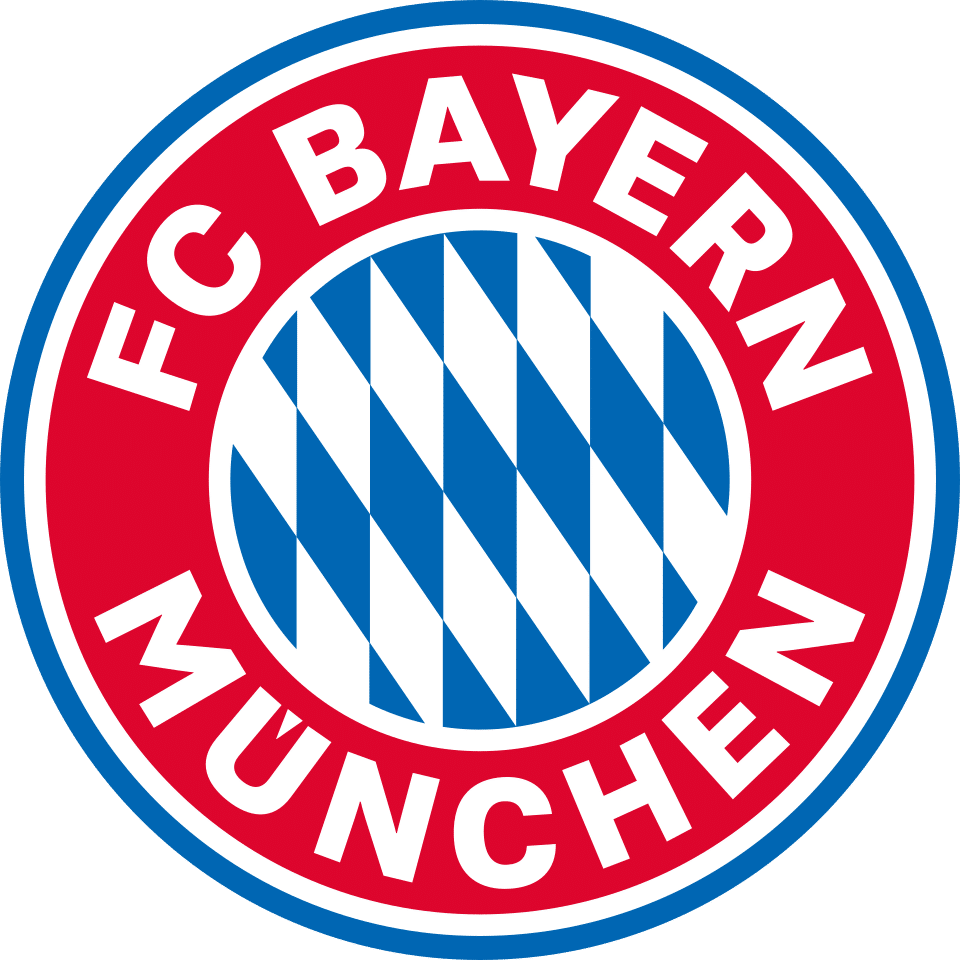
Kept the same overall structure as the 2002 badge but brightened and reworked the color palette: paler red was replaced with a warmer, darker raspberry-red tone and the blue was deepened, with minor font adjustments.
Why it changed: Club stated the change was to consolidate brand tone and increase visibility/consistency amid growing global non-football brand competition.
FC Bayern Munich logo 2024-present
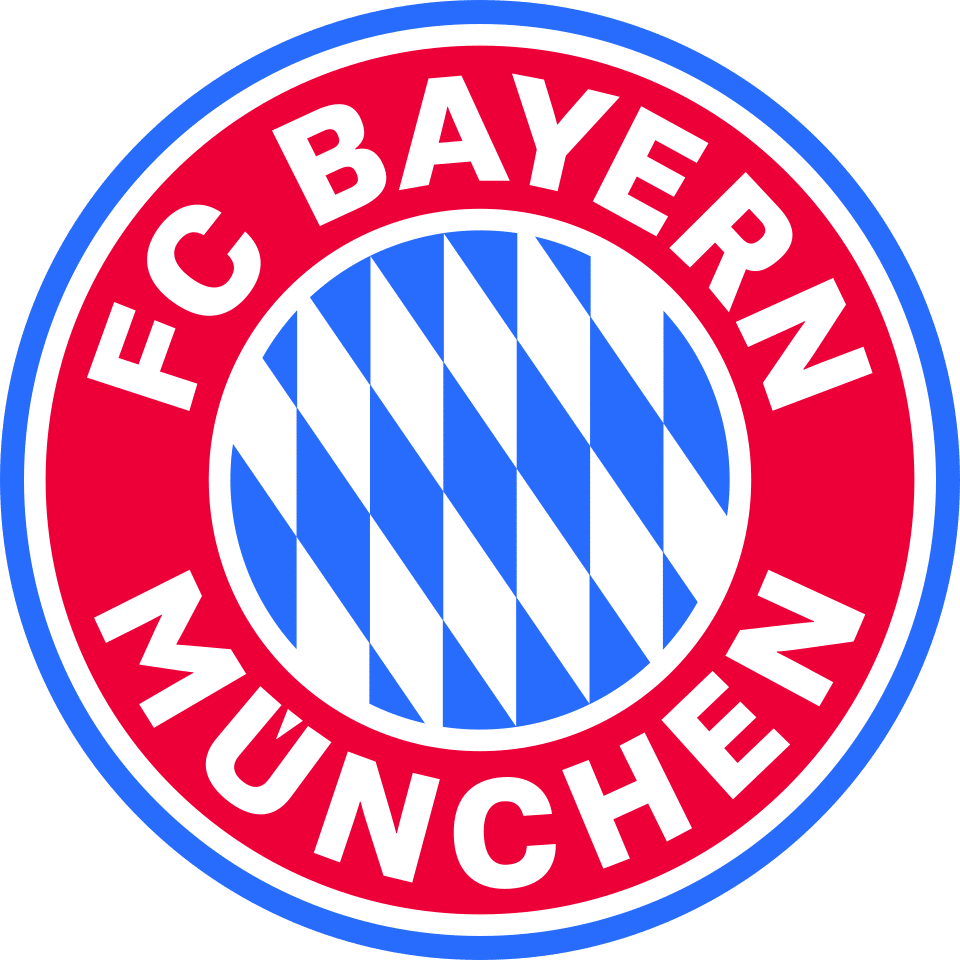
Same design as the 2017 badge but with both the red and blue tones adjusted to be slightly brighter, improving contrast between text and background.
Why it changed: Stated compliance with Germany's Barrierefreiheitsstärkungsgesetz (Accessibility Improvement Act), effective June 2025, to improve color contrast for people with disabilities.
FC Bayern Munich logo colors by era
| Era | Colors |
|---|---|
| 1900-1901 | Blue #1875B8White #FFFFFF |
| 1901-1906 | Blue #0076BC |
| 1906-1919 | Red #D42126White #FFFFFFBurgundy #D42126* |
| 1919-1924 | Red #DB1F19White #FFFFFFGreen #42673BBlue/white #FFFFFF |
| 1924-1954 | Blue #0B6DAC*White #FFFFFFGold #BB7948* |
| 1938-1945 | — |
| 1945-1954 | Blue #3289B6*White #FFFFFF |
| 1954-1996 | Red #F70000White #FFFFFFBlue #03316C |
| 1996-2002 | Red #CA1128White #FFFFFFBlue #193D7F |
| 2002-2017 | Red #ED1248White #FFFFFFBlue #2E6ABD |
| 2017-2024 | Red #DC052DBlue #0066B2White #FFFFFF |
| 2024-present | Red #ED0038Blue #286CFDWhite #FFFFFF |
Things worth knowing
- Bayern's original 1900 colors were blue and white; red became the primary color only in 1906 as a condition of merging with Münchner Sport-Club, giving rise to the nickname 'Die Roten'.
- The blue and white Bavarian diamond/lozenge pattern in the crest is taken directly from the coat of arms of the Free State of Bavaria, tying the club visually to its home region since the 1920s.
- From 1938 to 1945, under Nazi rule, the club's crest carried a swastika and the Reichsadler (imperial eagle) in its inner circle; club president Kurt Landauer, who was Jewish, had been imprisoned in 1938 and the club was branded a 'Judenklub' by the regime.
- The 2024 logo update was driven by an upcoming German accessibility law rather than a stylistic rebrand, only brightening the existing red and blue tones for better contrast.
Values marked * were measured from the logo artwork of that period. Brand color standards did not exist for most of these eras, so no official hex value was ever published for them. Treat them as an accurate reading of the artwork rather than as an official brand value. Unmarked values are the club’s own published colors.
Sources
- https://de.wikipedia.org/wiki/FC_Bayern_M%C3%BCnchen
- https://en.wikipedia.org/wiki/FC_Bayern_Munich
- https://1000logos.net/bayern-munchen-logo/
- https://www.designyourway.net/blog/bayern-munich-logo/
- https://www.thickaccent.com/2022/12/29/the-reason-why-bayern-munich-had-swastika-on-their-crest-from-1938-to-1945/
- https://www.footyheadlines.com/2024/10/new-bayern-munchen-logo.html
- https://commons.wikimedia.org/wiki/Category:FC_Bayern_M%C3%BCnchen_logos
- https://commons.wikimedia.org/wiki/File:FC_Bayern_M%C3%BCnchen_logo_(2024).svg
- https://commons.wikimedia.org/wiki/File:Logo_FC_Bayern_M%C3%BCnchen_(2002%E2%80%932017).svg
- https://commons.wikimedia.org/wiki/File:FC_Bayern_M%C3%BCnchen_logo_(2017).svg


